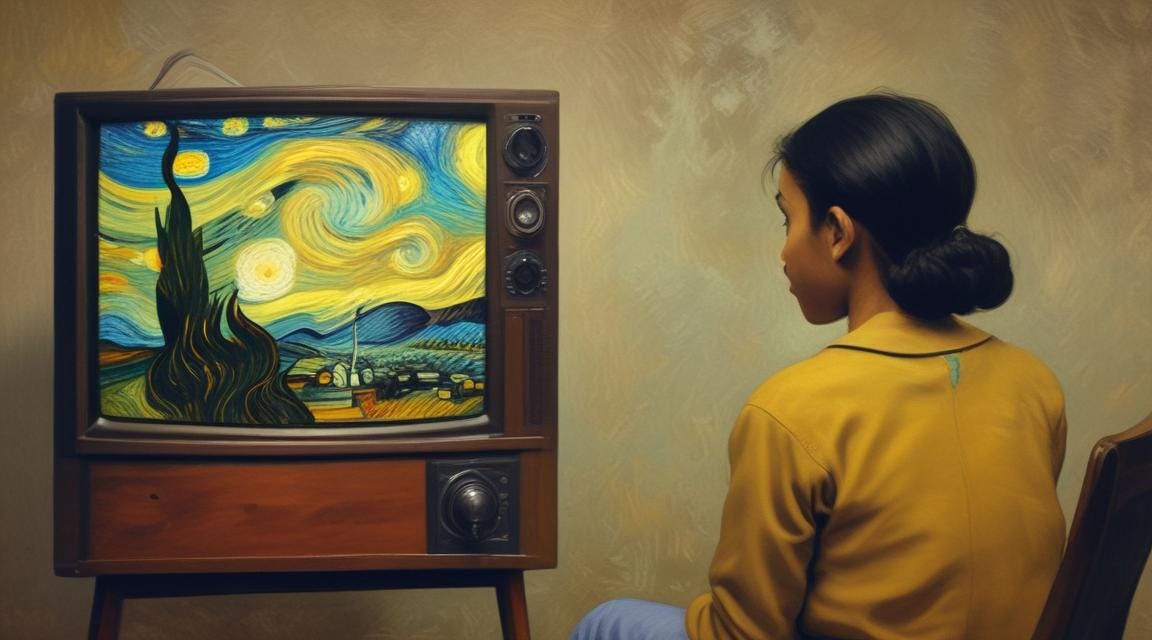
I went from reading 1 book a year to 32 — by changing one thing at dinner
How quitting TV gave me back my creativity, my hobbies and 31 hours a week
I went from eating dinner on a lap tray in front of the TV having read one book the previous year, to eating dinner at the table reading chapters aloud to my husband and getting through 32.
One change. Same evenings. Same amount of time. 31 more books.
That single shift — moving dinner from the sofa to the table — marked the beginning of the gradual decline and eventual complete demise of a routinely automatic habit that had quashed my creativity and held my mind captive for the best part of twenty years.
I started watching a lot less television. Then I stopped watching it altogether.
I haven’t really looked back since. And I haven’t missed any of it, at all.
But let me rewind, because this didn’t happen overnight. It started with a VHS player, a Disney film and a pair of smart parents.
The temple of TV
I had a sheltered childhood. First born, a girl, immigrant parents — I get it and I hold no grudges, mostly because I more than made up for all that lost time at uni.
My parents wanted me at home as much as possible because it meant they didn’t have to worry about me.
To encourage my complicity, I was given three unrestricted home freedoms:
I could wake up as late as I wanted on weekends
I could play my music loud — floorboard-shaking loud, usually Alanis Morissette’s Jagged Little Pill on repeat
I was allowed a TV in my bedroom
It’s only with adult eyes I see the common denominator. They all kept me confined to my room.
At about five or six, my parents taught me how to turn on the VHS by myself.
On Friday and Saturday nights they would set up a Disney film ready to go and instructed me that when I woke up the next morning, I was not to come into their bedroom but instead head downstairs, turn on the TV and press play.
They would wake up refreshed not long after. And I was delighted at having watched The Jungle Book for the fourth time that week. Everyone was happy.
Disney was the unpaid weekend babysitter and I turned out just fine.
But watching TV occupied the largest chunk of my free time as a child. And that pattern carried straight into adult life, completely unchanged.
Earning money replaced getting grades. Telly continued to occupy most of my evenings. My husband and I ate our meals in front of it, plates of food precariously perched on cushioned lap trays on the sofa.
I never questioned it. It was just what we did. It was just what a lot of people did.
The realisation that broke the spell
Then around 2018, I noticed something that made me stop.
I didn’t read books anymore.
I used to love books. I watched a lot of TV as a kid but I also read voraciously. Where had that gone? And if I wanted to read again, when would I do it? I worked from home so had no commute. By lights out I was too tired.
I needed something I did consistently every day that might be a good time to read.
I eat dinner every day. I could read then, instead of watching TV.
So I started doing that.
It meant my evening meals moved from the sofa to the dining table. Not long after, my husband followed, migrating to the seat opposite to join me. I began reading chapters out loud to him.
One book the previous year. 32 the next.
The same amount of time. The same evenings. The only thing that changed was what I did with them.
Then the pandemic arrived and something switched in me entirely.
When the national pastime became doom scrolling and tuning into daily death toll numbers, I wanted to retreat from screens altogether. No TV, no video, no news, no graphs.
It was a metaphorical dusting off my hands of the whole thing. I was done.
That was 2020. I haven’t gone back.
Half your free time, spent watching other people live
On average, people in the UK watch 4 hours and 31 minutes of TV, streaming and video content at home each day.
Let’s say you’re awake for sixteen hours and eight of those are spent at work or on responsibilities. Of the eight hours remaining, more than half is spent watching a screen.
Half your free time. Watching other people living their lives rather than living your own.
People regularly ask me how I fit in all the things I do. One of my answers is: I don’t watch TV.
According to that figure, this gives me an extra 31 hours of free time each week compared to the average person.
31 hours. That’s not a productivity hack, that’s nearly two extra waking days.
I often hear people say ‘there are not enough days in the week.’ There’s your extra day. It was in the living room the whole time, hiding behind a remote control.
If you are a person who watches a lot of television and you also often find yourself saying ‘I don’t have time’ — there might be a connection between the two.
Since I stopped watching TV, I read far more books. I have more time for my hobbies. I found the time to work out what my hobbies were in the first place. I rarely ask myself ‘how is it 10pm already?’
And I no longer get that weird, spaced-out feeling after finishing an episode — needing a moment to register where I am and what time it is — that always made me feel uncomfortable and resentful.
My husband and I make an over-exaggerated silly deal when I do actually sit on the sofa, because it happens about once a month.
It’s not the TV — it’s the autopilot
I should be clear: I am not anti-television. I’d be out of a job, for starters.
And I can list endless shows I’ve adored over the years — series and films that changed my view on the world and really made me think.
TV can be stimulating, comforting, educational, hilarious. It is part of our culture and we are really very good at making it.
The problem is not the thing. The problem is the relationship you have with the thing.
When consumption becomes mindless and automatic — rather than coming from a place of genuine desire and being fully present for the experience — it becomes a crutch. A pacifier. A means of avoiding sitting with yourself and your internal landscape.
There is a family I recently stayed with in Portugal. A household with no television, one laptop, and a seven-year-old who is not routinely permitted screen time — but it isn’t completely out of bounds either.
Because each Sunday is family film and pizza night.
I was invited to join and the experience was quite different to anything I had been used to.
The anticipation started at breakfast. Every second of the film was felt with each person’s whole being. After, there was a post-film chat about the characters at the dinner table while we finished our pizzas.
No adult looked at their phones. Once.
Then the laptop was packed away and this deeply appreciated, thoroughly enjoyed family occasion would happen again, the same time next week.
That is what intentional looks like. Not abstinence. Not guilt. Just choosing to be fully there for the experience rather than letting it wash over you on autopilot every night of your life.
How to reclaim your evenings
You don’t need to cancel your subscriptions or throw your TV out the window. But you might want to try one of these.
Move one meal to the table this week
No screen, no phone, just the food and whoever you’re eating with. If you’re alone, bring a book. This is the single change that rewired my entire relationship with TV. It sounds almost embarrassingly simple. It is. It also works.
Track your actual screen time for 7 days
Not what you think you watch — what you actually watch. Most phones track this for you. Most of us are shocked by the number. My Instagram alone was 34 minutes a day. Your TV habit is probably more. You can’t change what you can’t see.
Replace one evening scroll or episode with something you make
Cook something from scratch. Write something. Draw something terrible. Pick up an instrument. The shift from consuming to creating is the shift from autopilot to alive. It doesn’t need to be good. It just needs to be yours.
Try the Sunday night film
Make it an event. Build the anticipation. Choose something deliberately instead of scrolling for forty minutes and settling for whatever Netflix suggests. Watch it fully. Talk about it afterwards. Then turn it off.
One night a week of intentional watching is worth more than seven nights of background noise.
I have only the most cherished memories of my childhood
But following that film night in Portugal, I couldn’t help but feel something shift — a quiet recognition of just how many of my formative years had been spent worshipping at the temple of TV.
You can’t get those years back. But you can decide what you do with the ones ahead.
One book or 32. Same evenings. Same hours. Different choice.
The remote control has always been in your hand.
What would you do with an extra 31 hours a week? Tell me in the comments — I want to know.
I’m Leyla. I write about reclaiming your time, your attention and your evenings from the systems that want to keep you on the sofa. Amongst other things. I send this once a week to 8,000+ readers — join them if you’d like it in your inbox.
If this one landed, share it with someone who needs to hear it. And hit the ❤️ so Substack shows it to more people.