
Everything you want is on the other side of uncomfortable
On fear, inertia and what becomes possible when you stay in past the shock

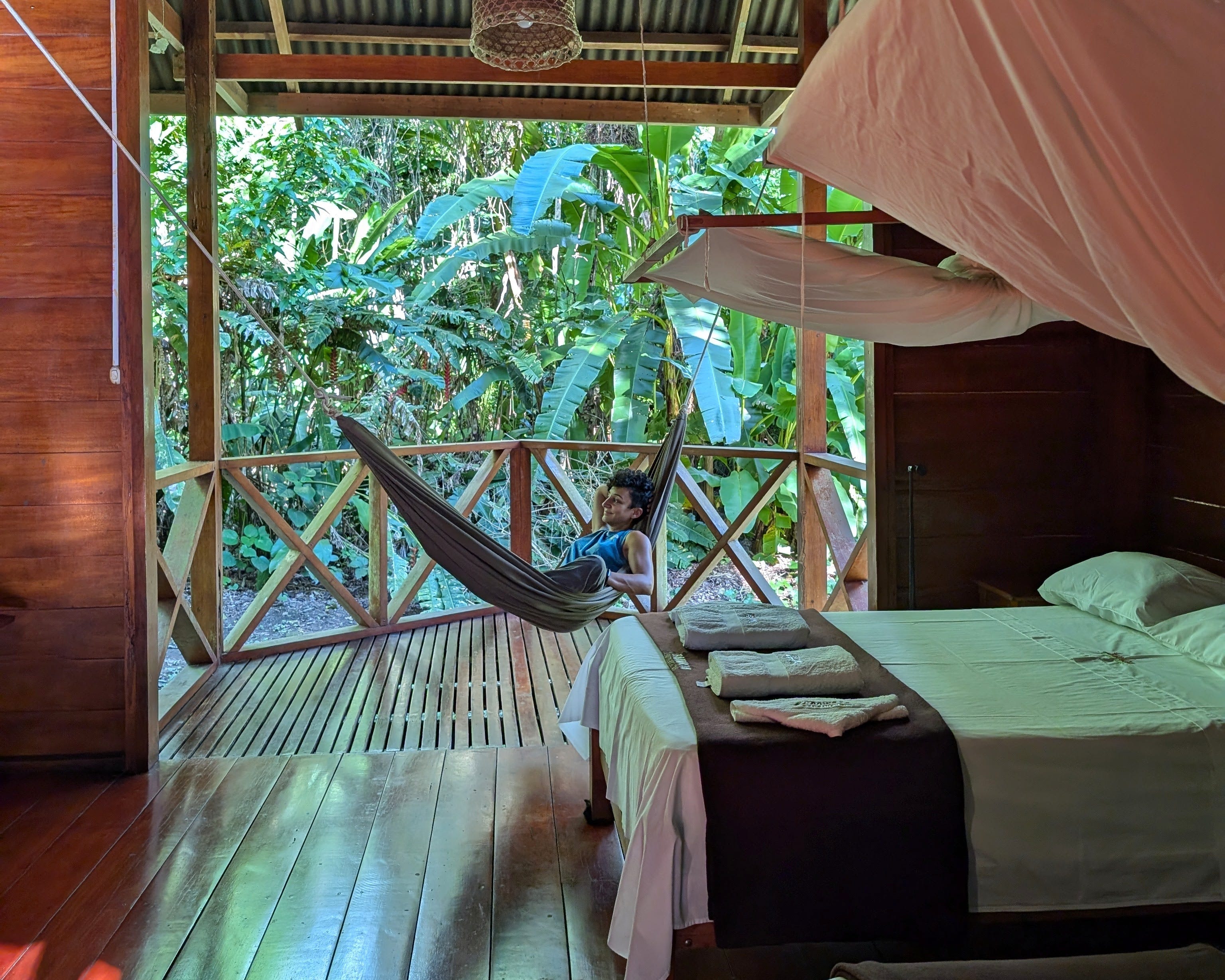
Intrepid Travel approached me with a commission: to write about my past travel experiences as part of the launch of their new Women's Expeditions in Peru, Bhutan and Cambodia.
I said yes immediately because comfort zones — and what’s on the other side of them — is a topic I think about a lot.
Plus, my relationship with Intrepid goes back years and I’ve been on many trips with them, including to the Peruvian Amazon. They’re awesome. I hope you enjoy this essay.
I once spent two nights sleeping in a wooden hut in the Peruvian Amazon with no wall on one end. It was just floor, then forest.
When it comes to nature, I’m a big fan.
But I turn into a quivering mess if I see a fat spider. Tarantulas, specifically, have their unique flavour of terror. My reflex if one randomly appears on a screen it to throw the screen or something heavy at it.
We had also been reliably informed that keeping food in your hut was a categorically bad idea because the critters would sniff it out a mile off and have no qualms entering for such rare loot.
My husband forgot he had half a chocolate bar in his rucksack. By checkout day, something had eaten a hole clean through the lining to get to it in the middle of the night.
On the second night, our guide offered a night time nature walk. I asked, as nonchalantly as I could fake it, whether we might see tarantulas.
‘I hope so!’ he enthused.
I nearly backed out.
I had images of bird-eating spiders the width of a man’s hand jumping from the trees and onto my face in the dark.
I went anyway.
We found their holes in the ground. He coaxed one out with a twig. I watched from 10 metres away, which felt close enough. And if I’m honest, closer than I had expected to make it.
I was kind of amazed I was there at all. In the rain, in the dark, surrounded on all sides by what was in my mind, a subterranean tarantula metropolis.
That trip was one of the most extraordinary of my life.
The ancient trees, the medicinal plants, the wildlife, the locals, the sounds, the water, the air — being in such an ecologically vital place felt like a massive, one-in-a-lifetime privilege.
None of it would have happened had I let the thought of a rogue tarantula wondering into my hut win.
This is what I’ve come to understand about comfort zones: the things waiting on the other side of them are almost always worth it.
The most dangerous place to hang out isn’t where you think
Nobody ever told me I should be suspicious of inertia and they should have. Because the most dangerous place you can be is not a dark car park or unfamiliar city.
It’s your comfort zone.
A typical Tuesday looks like every other Tuesday, which is exactly the problem.
I was chatting to my Uber driver in Birmingham recently. Father to an 18 month old with another on the way. I was in the car for almost an hour and we got straight into deep chat. He told me:
‘… and I thought, how shit is my life if I know exactly what I’m doing in two weeks time?
I’m going to wake up at 6am, go to work, have lunch, come home, do it again the next day.
And I thought nah man, this can’t be it. This can’t be all there is.
I much prefer the unknown.
My dream is to wake up and not even need to know what day of the week it is.’
He was 22 years old. It takes most people decades to arrive at the same realisation.
A 2023 study in The Journal of Positive Psychology asked people to deliberately do something outside their comfort zone for two weeks. Those with low life satisfaction saw measurable improvements within three weeks.
The anticipation of the scary thing was consistently rated as more distressing than actually doing it. And 70% of participants reported feeling courage, not just fear. (Russo-Netzer & Cohen, 2023.)
Most of us don’t blow up our lives on purpose though.
Most of us wait for the redundancy, the health scare, the crisis, the breakdown — the external event that forces the shift we were too afraid to just choose.
I know because I was one of these people.
I spent a decade in a corporate job screaming inside — is this actually it? — and getting mildly excited about a work conference because one night in a shit Holiday Inn at least meant something slightly different to a typical Tuesday.
The sameness was suffocating.
I eventually engineered my own earthquake because I finally came to the realisation of what staying was costing me.
What follows is what I’ve learned since about fear, the edge and why Nature has more to teach you about your full potential than any self-help book.
By the end of this you will have a framework for designing a life with more edge in it. And the understanding that the uncomfortable thing isn’t something to avoid; it’s a compass.
What your comfort zone is really doing to you
The edge effect
‘Transformation is not accomplished by tentative wading at the edge.’
— Robin Wall Kimmerer, Braiding Sweetgrass
In ecology, the edge effect describes what happens when two different environments meet.
It is at these boundaries — where air meets ocean, where river meets sea, where land meets coast — where you’ll find most of the the life on Earth.
Coral reefs are amongst the most abundant ecosystems on planet for exactly this reason. Estuaries, wetlands, coastlines – all teeming. Whereas if you head into the middle of a desert or the middle of the ocean, far from any boundary, there’s not a lot going on.
In Nature the safe middle is where things go quiet.
And this principle doesn’t just apply to ecosystems. It also applies to us.
Since moving to Portugal I’ve been living this in real time. Everything about me essentially stayed the same: the work, the interests, the way I think.
But I was suddenly in a completely new environment; two worlds collided.
It was really quite uncomfortable at first.
I got lonely. I didn’t speak the language. I didn’t know anyone. And my husband was still in the UK for those first five months.
But then something grew – at the edge.
I’ve made a friend here who is probably amongst the most sincere and valuable I’ve ever had. And I’ve known her just nine months.
The safe middle, by contrast, is where it all begins to blur into one amorphous smudge.
When all the variations and textures flatten into the same and the same and then more of the same.
It’s a bit like that line on a heart monitor screen. Life flickers — heartbeats, seasons, the long slow flicker between one version of yourself and the next.
The spikes are good, they are life; flatlining is not a desirable outcome.
The comfort zone was designed
Believing that staying within the confines of our comfort zone is in our best interest is quite convenient for the systems that do not serve us.
We are already managing all aspects of our increasingly unsustainable lives: careers, relationships, health, children, households, never ending life admin.
Pushing ourselves beyond our comfort zone feels like yet another item on the to do list; staying put is far less effort.
And isn’t that just ideal. Because heaven forbid we realise what we are actually, fully capable of.
The media plays a big role in this.
A friend told me recently that in Italy, if a woman is killed — obviously an awful but, contextually, infrequent event — there will be rolling live news about it for hours and hours.
And all that coverage actually does is make people watching feel like perhaps it’s safer to just stay at home.
And this is how society shapes our reality – through a curated stream designed to keep us afraid and compliant rather than through our own senses and experiences and critical thinking.
And then there’s the conveyor belt of societal conditioning. The one we stepped onto so young we didn’t even realise there was an alternative: to step off.
Do well at school → get into a good university → get a good degree → get a good job → earn good money → get on the property ladder → get married → have kids → work hard until you’re 65 → congratulations, you’ve won a handful of remaining years to enjoy yourself, if you remember how.
Nobody asked if this was the life you actually wanted. It was simply the life that was expected.
School is babysitting for children. Modern office work is babysitting for adults. But why the hell do any of us need to be watched and controlled like we’re toddlers in the first place?
What happens when you engineer the earthquake yourself
I quit my corporate job at 29 with no plan, spent nine months travelling the world, never had a boss again.
I went on to build a media career entirely on my own terms, present on the BBC, publish books and eventually buy three acres of land in rural Portugal where I’m currently building an eco eco-house.
I am not special. I’m just someone who looked at the flatline and said - nah.
Feelings of pissedoffness about all of this is fine. But awareness is what you actually need because that is what changes things. If you don’t even know you’re in the room, how can you possibly expect to find the door out?
It’s on the other side of that door you’ll find the version of you the systems would very much prefer you never met.
How to design your life for more edge
‘If you met yourself at full potential, it would feel like divine guidance.’
— Charlie Morley
The vast majority of people never meet that person because they quit too soon.
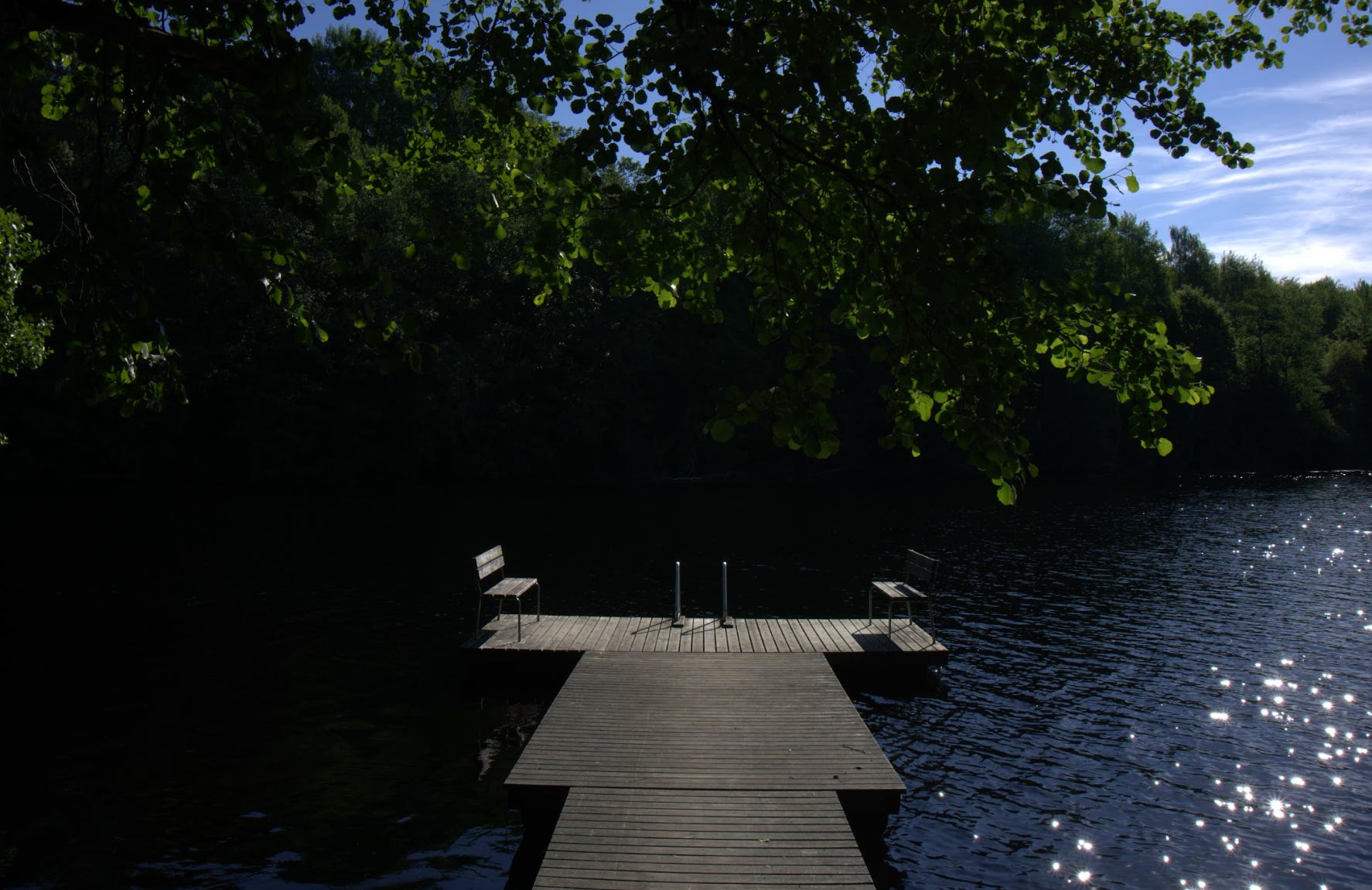
In Finland one summer, I spent a night in a wooden hut in the woods with a group of women I’d just met. The evening consisted of: smoke sauna, cold lake plunge, repeat.
The night was nectar.
After a couple of rounds I noticed: if you stay in the heat a little beyond what you thought you could tolerate, then follow it by staying in the cold a little beyond what you thought you could tolerate, the gasping and shaking stops.
What followed was an unexpected and enveloping euphoria that swallowed me whole, a completely natural and really quite intense high. It was totally amazing. I felt like I had discovered some ancient secret the rest of us are only just catching onto.
But — it only works if you stay in long enough.
I explained all of this to the group and they all wanted a piece of it. But not one of them (other than our Finnish guide, obvs) could stay in long enough to get there. Even knowing what was on the other side, the temporary discomfort was just too much for them to bear.
Whilst riding my cosmic wave or whatever it was, I felt bad for them — they were missing out.
The steps below will help you do the things that are not easy and get acquainted with what’s on the other side.
Because let me tell you, you don’t want to miss out on that.
Step 1: Name your flatline
Look at your week honestly and assess if there were any moments where you felt genuinely challenged.
I don’t mean annoyed or busy, I mean actually stretched – in a good way. Not being certain how something will go usually accompanies this.
If the answer is no then that’s your baseline.
Write down the one area of your life that has felt most static. Not necessarily broken or dramatically terrible. Just... a lot of the same.
You can’t find the edge until you know where the middle is. If you want to change something, the first step is always awareness and that requires you to actually look at the thing.
Step 2: Find where two worlds could meet
I’m a writer who is having a go at making wine; I’m a city gal pulled towards rural land; I’m a millennial brought up on the internet who always wants to learn a practical skill.
Ask yourself: what two identities or interests do I hold that I’ve never deliberately brought together? That overlap is almost certainly your most fertile ground.
You need to put yourself somewhere two different worlds are bumping up against each other and see what grows.
If you want more life, design for more edge.
Step 3: Do the thing that makes you want to vomit
This is not a metaphor.
When I receive an email about an opportunity that makes me think holy Jesus feck this is going to be terrifying, I immediately respond with a big fat YES.
The terror is the signal. The nausea, the stomach drop, the heart-in-mouth — these are all compasses not stop signs.
I remember the first day I filmed MasterChef. Sitting at the critics’ table alongside two industry heavyweights with 25 years of experience each, feeling like I might barf.
And then we started rolling and I realised: everyone is just a person.
Everyone is winging it. Everyone is pretending at least a bit. Everyone is just trying their best. Once I understood that, the fear basically had nowhere left to go.
What is the thing you keep not doing because it seems so scary that it makes you want to heave?
That’s the thing you need to just do.
Step 4: Stay in past the shock
This is when most people quit.
They get in to that cold lake, get winded by the shock, get straight back out and go back to their lives believing the whole thing just isn’t for them.
But think about pruning a tree in winter while it’s dormant. It’s pretty violent, hacking off whole parts of the plant. And yet the following spring, a pruned tree puts on more new growth than one left untouched.
The enforced hardship is the point.
Don’t confuse the initial shock with the full experience because they are not the same thing. If you want the euphoria, you have to endure past the gasp.
Step 5: Let it be collective
With that same group of women in Finland over dinner that night, one woman opened up about her endometriosis. I had never even heard of it (this was quite a few years ago).
And I remember thinking: how cool that she felt at ease with this group enough to bring this up and I’m pretty sure I would never have learnt about this thing at a mixed dinner table.
No shade cast on our male friends, of course. But in the same way certain topics will only surface amongst certain company, the same goes here.
But what I remember from that evening the most was the laughter. The kind that doesn’t take long to tip over into the slightly ridiculous where you can’t even remember what set you all off in the first place. It must have been all that fresh air.
There are few joys as purely distilled as the joy experienced by a group of women putting the world to rights, planning what they’d do if they ran the whole damn show and laughing until someone has to ask everyone if they could please keep it down.
So often women are thinking the same things, occupied by the same worries, experiencing the same niggles. But there just aren’t enough spaces where those things get said freely, when the conversation just gets there without anyone having to be brave enough to ‘go first’.
And when you’re all thrown into the unfamiliar together and you all feel a bit out of your depth, experiencing something new in an unfamiliar place, a very particular kind of bond forms. One that lasts beyond Instagram updates and hasn’t faded by the next week.
This is why Intrepid Travel’s new Women’s Expeditions to Cambodia, Peru, and Bhutan sound totally brilliant to me. I’ve been on a number of fab group tours with Intrepid, but never a women’s only one.
In Cambodia, female guides walk you through the history the textbooks left out. In Peru, you hike ancient Inca trails with an all female crew of porters before arriving at Machu Picchu. In Bhutan, you climb a cliffside to a monastery that's been hanging there since the 17th century, then decompress with a sound bath in pine forests.
These places are incredible destinations in their own right.
But it's the fact you get to discover them, and all the associated feels, with a bunch of women who know things. Strangers all thrown into the unknown together in places far enough from the familiar that two worlds collide. A deliberately designed edge.
I think this would be marvellous.
Step 6: Notice what grows
So, you’ve now done the scary thing.
The day after, the week after, ask yourself: What do I know now that I didn’t before? What did I find out I am capable of? What did that fear turn out to actually be?
Build your evidence base.
If you want to return to the edge, you need proof you survived it the last time (because you will forget). Think of it as an archive of your own capability.
Because the fullest version of yourself is waiting on the other side of the thing you keep not doing.
Final thoughts
Do the thing you initially thought you weren’t capable of doing. Because you literally are capable of it; there’s no other way for me to say this.
The very fact that it makes you feel scared indicates you should not immediately dismiss it. That fear is your body paying attention to the rustle in the bushes. It’s this signal that is telling you, this matters.
Also, it’s just kind of boring to be comfortable all the time.
We can only experience joy because we know what sadness feels like. Light is only a thing because there is also dark. If everything was always the same texture, there wouldn’t even be a word for ‘comfort’ because there would be nothing to compare it to.
The fact anything exists is because its opposite does too.
It’s the unending sameness that is the danger. Not the unlit car park, not the unfamiliar city – the flatline. Decade after decade of the same, until you arrive at your later years and realise you never really pushed yourself in any meaningful way.
Never found out what was on the other side of the shock. Never stayed in long enough to feel the euphoria.
There is almost nothing to lose by trying and yet everything to potentially gain.
Go find your edge.
What’s your scary thing? The one that’s been the one for a while now. Let me know in the comments.
I'm Leyla. I write about why turning your energy towards the hard thing is worthwhile, amongst other things. I send these to 10,000+ readers — join them if you'd like it in your inbox.
If this one landed, share it with someone who needs to hear it. And hit the ❤️ so Substack shows it to more people.