
The hidden bullshit tax you pay every time you downplay your life
We've been conditioned to believe joy needs to be earned through struggle. But what if that's a lie?


I was actually grateful for a (really bad) allergic reaction.
Let me explain.
A few months ago I announced that I would be making a wine with my local organic vineyard here in Portugal. It was an opportunity borne out of friendship that aligned with all of my values.
It happened within three months of my debut book being published and within weeks of me moving to a new country. It was very serendipitous.
It feels ridiculous admitting this, but I was conscious that this might come across as oh look, yet another thing working out for Leyla Kazim.
So, when I developed acute contact dermatitis during the first grape harvest — a nasty reaction that left me housebound for two weeks looking like a cross between Shrek and an Avatar character — a bit of me was, dare I say it, secretly relieved.
Here was the struggle I could pair alongside the happy announcement. The thing that showed I was human. The thing that would make my news more palatable.
I was actually grateful for the hardship simply so that I had something negative to write about, for once.
I fully acknowledge how 100% fucked up thinking this is, btw.
But it reveals something important. Not about me — about the unspoken rules of how we’re allowed to share our lives.
We have been conditioned to believe that for a story to be valid, it must follow a specific formula: adversity, low point, hard-won recovery.
If you skip the misery and go straight to the joy, people find it hard to connect.
I noticed this when I wrote an essay about quitting Brazilian Jiu-Jitsu.
I knew people would enjoy it because it showed I am fallible — which I obviously am. That post got restacked and referenced by other writers in a way my celebratory posts rarely are.
The broken bits got more love than the brilliant bits. Every time.
This is the bullshit tax we pay to stay ‘relatable.’ And I want to talk about why we pay it, what it’s actually costing us and why I’ve decided to stop.
Why we only trust joy when it comes with a side of suffering
There’s actually a name for this in psychology. It’s called the Pratfall Effect.
It says that when a person is perceived as competent or successful, they become more likeable only after they show a flaw or make a mistake. The stumble humanises them. Without it, their competence triggers discomfort rather than admiration.
In other words: we have psychologically wired ourselves to only accept someone’s success once they’ve tripped up in front of us.
This is also 100% fucked up.
But it explains everything. It explains why we froth at the mouth when something goes wrong for a sleb but we barely blink at the 20-year marriage or steady career climb.
It explains why social media rewards vulnerability porn over genuine celebration. It explains why the dominant emotional register of the internet is annoyed and/or complaining.
We have decided that complaining is the only ‘authentic’ way to connect.
Hannah Gadsby nailed it in Nanette:
“I have built a career on self-deprecation, and I don’t want to do that anymore. Because you know what self-deprecation is from someone who already exists in the margins? It’s not humility. It’s humiliation.”
That landed on me like a truck.
Because here’s what the relatability trap actually costs you.
Every time you downplay something good in your life — every time you pair your joy with a qualifying struggle — you are training yourself and your audience to believe that happiness needs to be earned through pain.
You are paying a tax on your own contentment. And the tax collector is everyone else’s discomfort.
But if one person’s joy makes another uncomfortable, that is a sign for them to look at their own shadows. It is not a sign for you to dim your light just so they don’t have to squint.
What if a crisis is just a data point?
It’s not that challenging things never happen to me. I am not sipping Vinho Verdes under the sun and lolling about in tascas 24/7 without a care in the world.
I experience everyday niggles and annoyances and the bigger things as much as the next person. But I have realised that what many call a bad break, I mostly view as a simple data point — and often, an opportunity.
When my husband had to return to the UK unexpectedly two weeks after we moved to Portugal, I was left alone in a new country for four months. Totally unplanned.
A friend said on a Zoom catch-up, ‘Wow, that’s a long time. How are you coping?’
And I thought — what an interesting choice of words. Like, now I see that this would be considered a hardship to many people. Perhaps even a ‘terrible start’ to the new chapter.
But I just didn’t see it like that.
Yes, I felt a bit lonely at times. I missed my family and my husband (occasionally, haha). I had one wtf am I doing here? wobble on the balcony one evening. And I even panic downloaded Bumble For Friends at 3am.
But mostly, I saw this time on my own as a once-in-a-lifetime opportunity.
Not because I’m ‘strong.’ I just actively and consciously made the choice to think that way.
I viewed it as a chance to force myself to meet people and take in a new culture without the comfortable crutch of a partner always around.
I turned up to events on my own, spoke to others and built a new circle of friends. I wouldn’t have made those friends so quickly if I hadn’t been in Portugal alone.
The difference isn’t personality. It’s a decision. I believe most things can be figured out. And when you take a moment to zoom out and look at the sky, most things are — in the grand scheme of things — not actually that bad.
And even when they are, there are always silver linings.
Reach for the better feeling thought.
The other side looks like this
Personally, I operate in the complete opposite direction to the Pratfall Effect.
When I see someone has made loads of money, landed a massive deal, published a book or achieved a big-ass qualification, my immediate response is: Bloody GOOD FOR YOU. Bloody well done!! Bloody smash it uuuuup!!!!
I often literally say these words out loud. I love seeing people design their own lives and achieve things.
Because — why wouldn’t I?
It’s not like there is a finite amount of success in the world and other people achieving theirs leaves a little less in the pot for everyone else. Classic scarcity mindset.
Their success is all our success. They are not special. Neither am I. Neither are you. No one is more special than anyone else. Their success shows that if they can do it, anyone can. Other people’s wins show me what is possible.
I find success stories inspiring — with or without the adversity — pretty much every single time.
As I write this, Storm Ingrid is blowing sheets of rain sideways. There hasn’t been a shaft of sunshine in days and it is exceptionally cold and grey. I am wrapped up in layers just as I would be in London. And I am once again living solo for the next couple of months.
And yet, I feel good. Really good.
I feel excited because I have decided the Universe is on my side and looking out for me because I allow it to. What an absolute privilege it is to get to wake up at the start of a new day and try it all again.
That is my unfiltered truth. And I’m done apologising for it.
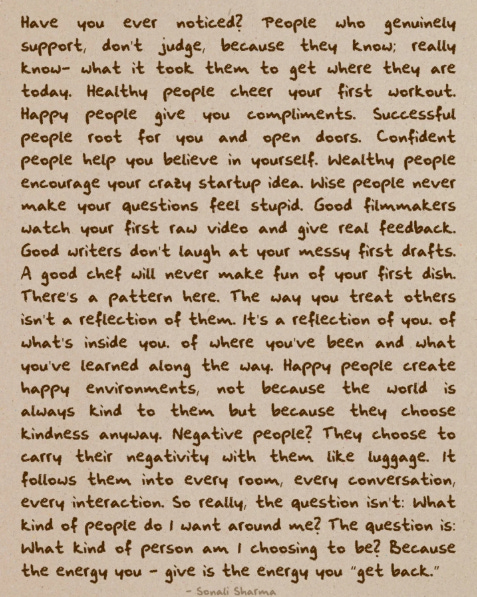
How to stop paying the bullshit tax
Here’s what this looks like in practice — not as a personality trait but as a set of choices anyone can make.
Stop qualifying your good news
Next time something good happens and you want to share it — a promotion, a holiday, a win, even just a really good Tuesday — share it without the caveat.
No ‘but it wasn’t all smooth sailing.’ No ‘I know I’m lucky.’ Just the joy, uncut. See what happens. The people who can’t handle it are telling you something about themselves, not about you.
Catch the Pratfall reflex in yourself
Notice when you feel a flash of comfort at someone else’s failure, or discomfort at their success. You’re not a bad person for feeling it — it’s the Pratfall Effect doing its thing. But once you see it, you can choose differently.
Try replacing the flinch with ‘bloody good for them’ and mean it. It gets easier.
Reframe your next setback as a data point
The next time something goes sideways, before you spiral, ask: what is this actually? Not what story am I telling about it — what is the fact of it?
Often the ‘crisis’ shrinks to a logistical problem with a solution. The drama was editorial, not structural.
Curate for joy, not just commiseration
Look at who you follow, what you read, what you talk about with friends. How much of it is bonding over what’s broken? How much is celebrating what’s working?
If the ratio is skewed, adjust it. Not because negativity is invalid — but because it cannot be the only frequency you tune to. You become what you give your attention to.
Your joy does not need a permission slip
It does not need to be earned through hardship, softened with a struggle or made palatable with self-deprecation.
You are allowed to be excited about your life. You are allowed to wake up thrilled about the day. You are allowed to say things are going well without whispering it.
I am choosing to not dim my light just because it might make others squint. And I think you should try it too.
It is easier to complain together than to grow together. But growing together is much more fun.
What’s one piece of good news in your life right now that you’ve been quietly downplaying? Share it in the comments — no caveats allowed.
It would be so nice if more people were able to feel this. I think we could bond over excitement and joy just as easily as we bond over the 💩.
I'm Leyla. I write about refusing to apologise for designing a life that actually excites you, amongst other things. I send this once a week to 8000+ readers — join them if you'd like it in your inbox.
If this one landed, share it with someone who needs to hear it. And hit the ❤️ so Substack shows it to more people.